A Typical Engagement

Understanding how your dealership really operates takes time.

There are common features in all dealerships, but most businesses have unique ways of doing things that work well for their people and their customers.

On this page we explain what CrowToes does to ensure our plan for implementation is grounded in the facts on the ground at your business, rather than abstract assumptions about common processes.

To start your engagement with CrowToes, take advantage of our diagnostic tool.

Reality Before Recommendations

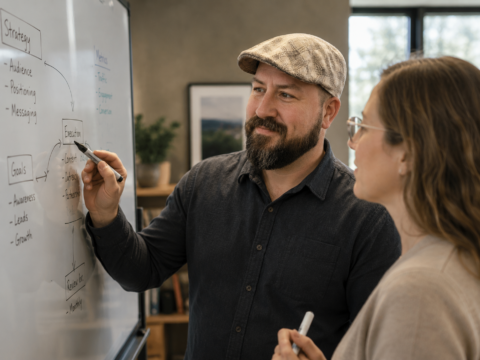
Before recommending changes, CrowToes spends time observing the operation, building an understanding of how it functions, and validating that understanding with the people closest to the work.

A typical engagement begins with two to three days on-site.

First Morning (on site)

  • Meet with ownership and key stakeholders
  • Learn how the business is supposed to operate
  • Begin identifying key processes, systems, and responsibilities

First Afternoon (out of your hair)

  • Organize observations and notes
  • Draft an initial model of the operation
  • Identify questions, assumptions, and areas requiring clarification

Second Morning (on site)

  • Review findings with the team
  • Clarify and verify assumptions
  • Compare notes with the people closest to the work

Second Afternoon (out of your hair)

  • Continue refining the model
  • Identify bottlenecks, friction points, and coordination challenges
  • Document opportunities for improvement

Third Moring (on site)

  • Validate the refined model
  • Discuss edge cases, and operational realities
  • Explore priorities and possible approaches

Third Afternoon (if necessary)

  • Confirm understanding with the client
  • Finalize observations and documentation
  • Begin preparing for solution design

This process is built around three recurring activities:

Observation

Process Modeling

Validation

Observation

Understanding how a dealership operates begins with observation.

During the first phase of an engagement, CrowToes spends time inside the business observing how customer-facing operations function day to day. This includes conversations with ownership, office staff, sales teams, coordinators, and anyone involved in moving opportunities from first contact through closed sale.

We look at how leads enter the business, how information moves between departments, how customer requests are handled, and how employees navigate the exceptions, workarounds, and edge cases that naturally develop over time.

The goal is not to evaluate whether processes are right or wrong. The goal is to understand how the dealership actually operates before drawing conclusions or making recommendations.

What We Watch For:

  • How opportunities enter the business
  • How information moves between departments
  • Where bottlenecks slow progress
  • Where responsibilities become unclear
  • Where processes vary between employees
  • Where opportunities are most likely to fall through the cracks

Process Modeling

Observation alone is not enough.

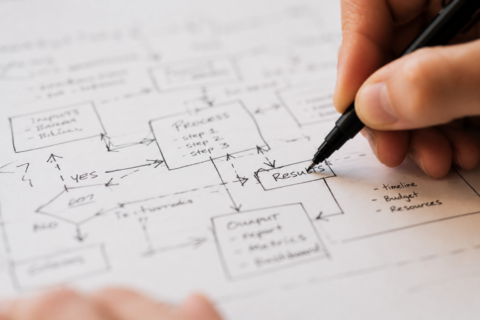
After spending time inside the dealership, we organize our observations, document workflows, and begin building a model of how customer-facing operations actually function. This work helps transform individual conversations, observations, and process details into a more complete picture of how opportunities move through the business.

As the model develops, bottlenecks, dependencies, exceptions, and coordination challenges often become easier to identify. It also helps uncover areas where additional questions need to be asked before recommendations can be made.

The goal is not simply to document processes. The goal is to understand how the operation functions as a system so that improvements can be designed around the realities of the business.

What We Model:

  • Lead-to-sale workflows
  • Department handoffs
  • Decision points and exceptions
  • System interactions and dependencies
  • Sources of operational friction
  • Opportunities for improved reliability

Validation

Dealership operations are complex, and initial assumptions are often incomplete.

After developing a working model of the business, we return to the dealership to review findings, ask follow-up questions, and validate our understanding with the people closest to the work. This often includes discussing edge cases, resolving conflicting information, and taking a closer look at processes that require additional clarification.

Validation helps ensure that recommendations are based on reality rather than assumptions. It also provides an opportunity to identify details that may not have been visible during the initial observation phase.

The goal is simple: before recommending changes, we want confidence that our understanding accurately reflects how the dealership actually operates.

What We Validate:

  • Workflow assumptions
  • Department responsibilities
  • System interactions and dependencies
  • Exceptions and edge cases
  • Bottlenecks and friction points
  • Areas requiring additional investigation

Rapid Iteration Creates Deeper Understanding

The value of spending multiple days on-site is not simply the amount of information collected. It is the ability to continuously refine our understanding of the operation.

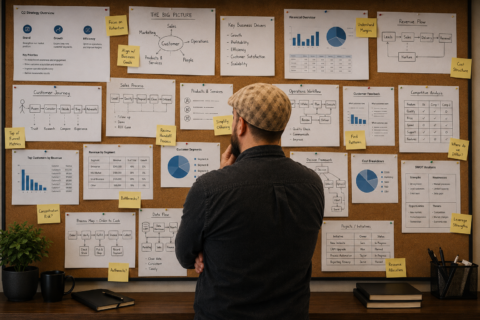
Each afternoon, we get out of your hair and organize observations, conversations, and notes into workflow diagrams, process maps, responsibility charts, to model how information moves through the business. Questions, contradictions, bottlenecks, and missing information are documented so they can be explored the following morning with the people closest to the work.

Those conversations lead to new observations, new questions, and a more accurate understanding of the operation. The cycle then repeats.

By the third day, we are often discussing edge cases, exceptions, and operational details that would never surface during a traditional discovery process because the larger picture has already been established and tested.

The key takeaway:
We don’t document processes for the sake of documentation.

The process described above does give us notes that we can refer to, and that is great. But the point of the in-person iteration and investigation is to help us internalize the information so that we can design improvements that fit the realities of the business and the people responsible for making it successful every day.

From Understanding To Action

By the end of the on-site engagement, we are no longer trying to understand the operation. We are working from an understanding that has been observed, modeled, and validated with the people closest to the work.

That understanding makes everything that follows easier.

The result is a smoother path from problem identification to practical improvement, with fewer surprises, fewer misunderstandings, and a much higher degree of confidence that the changes being made will fit the way the dealership actually operates.

Ready To Find Out What’s Possible?

If you’re curious how much growth may be hiding inside your existing operation, the Lead-to-Sale Diagnostic & Opportunity Calculator is a great place to start.